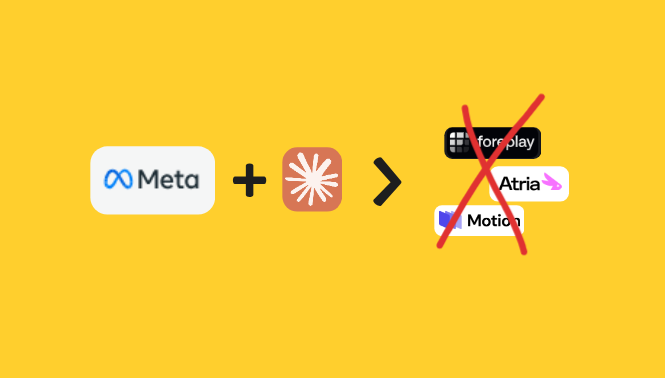
For years, a cottage industry of third-party tools propped up the gap between Meta's raw ad data and what advertisers actually needed: fast creative research, competitor intelligence, and performance analytics they could act on. Foreplay saved and organized competitor ads. Motion told you which creatives were burning out. Atria let you search the Ad Library like a pro. Advertisers paid hundreds of dollars a month for each of these.
On April 29, 2026, Meta quietly made most of that unnecessary.
What Meta Actually Launched
Meta announced Ads AI Connectors in open beta, giving advertisers and agencies the ability to manage, analyze, and build campaigns directly through AI agents, no developer credentials, no custom code, no waiting.
The connectors ship as two components:
- Meta Ads MCP Server (Model Context Protocol): A secure, authenticated bridge between Meta's ad system and any AI agent that supports MCP, including Claude.
- Ads Command Line Interface (CLI): For teams that prefer terminal-based workflows.
Setup takes minutes, not days. And once connected, the AI agent has direct access to your real account data, not generic advice scraped from help docs.
What It Can Do
The four capabilities Meta is shipping cover exactly the ground that third-party tools used to own:
- Comprehensive Reporting. Generate detailed campaign performance insights on demand. Ask your AI agent how your top creatives performed last week. Get breakdowns by ad set, audience, and placement. This is Motion's core value proposition, delivered natively.
- Campaign Management. Create and modify ads, ad sets, and campaigns using natural language. No more bouncing between Ads Manager tabs. Tell your AI agent to duplicate the best-performing ad set and adjust the budget. Done.
- Catalog Management. Build product catalogs, manage data feeds, and resolve feed issues through the same interface. For e-commerce advertisers running dynamic ads, this alone eliminates a category of painful manual work.
- Signal Diagnostics. Monitor pixel health, signal quality, and event match scores. The kind of debugging that used to require a developer now happens in a conversation.
Why This Kills the Third-Party Stack
The tools this displaces were never the real product. They were workarounds.
Foreplay and Atria built businesses on top of the Facebook Ad Library because Meta's native search was terrible. You couldn't filter by industry, save ad collections, annotate competitors, or build swipe files. Foreplay fixed that for creatives. Atria fixed it for media buyers. Both charged accordingly.
Meta hasn't fixed its Ad Library search. But it has done something more disruptive: it has given AI agents authenticated access to real ad data from your own account. The competitive research use case still exists, but the "manage and analyze your own ads" use case, which is the daily driver for most teams, is now a native AI workflow.
Motion built its entire business on creative analytics: telling you which of your Facebook ad creatives were fatiguing, which hooks were working, and when to rotate. That analysis now lives inside any AI agent connected to your Meta account via MCP. Ask Claude to pull your top five creatives by CTR over the last 30 days, compare them against spend, and flag anything with declining performance. You just replicated Motion's core dashboard in a single prompt.
The MCP Angle Is Bigger Than It Looks
Most advertising coverage of this launch has focused on the campaign management angle. The more important story is the protocol.
Meta shipping an MCP server means Meta advertising is now a first-class tool in the AI agent ecosystem. Claude, GPT-based agents, and any other MCP-compatible AI can now connect to Meta's ad system with the same architecture used to connect to databases, APIs, and internal tools.
This is not a chatbot bolted onto Ads Manager. This is Meta exposing its ad system to the agent layer of the internet. The practical implication: your AI agent can now run a campaign, check its performance, tweak the budget, diagnose pixel issues, and pull a board-ready report, all in the same session, without switching tools, without a third-party subscription, and without a developer.
What Third-Party Tools Should Do Now
Not all of these tools are dead. But the generic versions are.
The tools that survive will be the ones that go deeper on the use cases Meta can't or won't own. Creative research across competitors at scale, brand tracking, multi-platform swipe file management, and creative strategy workflows that combine ad data with broader market context. These require scraping, editorial curation, and cross-platform aggregation that Meta will never build.
The tools that are in trouble are the ones whose primary value was "Meta's data, but in a better UI." That value is now zero.
How to Connect Meta Ads to Claude Today
Meta's Ads AI Connector is in open beta. To get started:
- Go to the Meta Business Help Center and follow the MCP server setup instructions.
- Authenticate your Meta ad account through the connector.
- Add the MCP server to your AI agent (Claude Desktop supports MCP natively).
- Start querying your campaigns in natural language.
The YouTube walkthrough "How to Install the Official Meta Ads MCP in Claude" covers the full installation in a few minutes.
You're Still Paying $100+ for Two Features
Here's the uncomfortable math. Foreplay, Motion, and Atria all charge north of $100 a month. Meta just gave away most of what they sold. What's left? Brand spy and ad search. That's it. That's the remaining moat.
And while brand spy and ad search are genuinely useful, they are not $100-a-month useful when that's the only thing you're getting. You're paying a premium price for a tool that used to do ten things and now does two.
The smarter move is to use a smaller, focused tool built specifically for ad research and ad spy, not a bloated platform that's scrambling to justify its pricing after Meta ate its core features. That's exactly what Spreshapp is. Ad spy and competitor ad research, nothing else, at $19 a month. No upsells for features Meta now handles for free.
The Bottom Line
Meta just handed advertisers a direct line between their AI agent and their ad account. No middleware. No monthly SaaS fee. No API wrapper built by a startup.
The third-party tools built on top of Meta's ecosystem have been racing against this moment for years. Some of them knew it. The smart ones diversified. The rest just watched their core value proposition become a native feature of an open beta.
This is not a warning shot. The shot already landed.